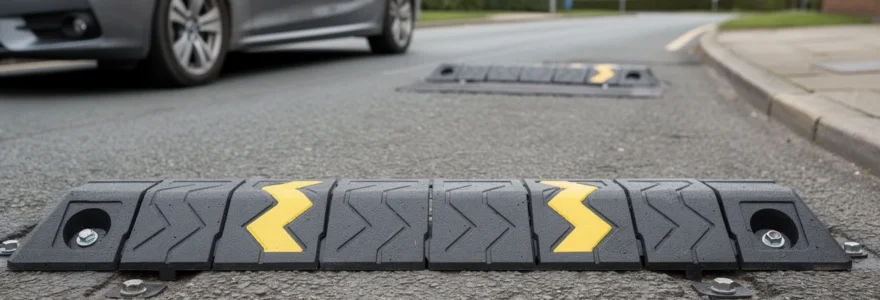
Rubber speed bumps have become one of the most practical traffic calming tools available to UK site owners, facilities managers and highways professionals. Unlike cast-in-place asphalt humps, they can be installed in hours rather than days, removed or relocated without specialist plant, and often outperform tarmac on durability and vehicle wear. But “rubber speed bump” covers a wide range of products, from lightweight car park sections to HGV-rated modular systems built for industrial yards. This guide explains what rubber speed bumps are made from, how they compare with traditional tarmac humps and other materials, the height and gradient specifications that govern their performance, and how to install them correctly. Whether you’re specifying calming for a private estate, a bus route or a retail car park, understanding these distinctions will help you choose a product that actually solves the problem rather than creating new ones.
What are rubber speed bumps and how do they differ from traditional tarmac humps
A rubber speed bump is a pre-fabricated, modular traffic calming device made from recycled or moulded rubber, bolted or bonded to an existing road surface rather than built into it. This is the fundamental difference from a traditional asphalt hump: an asphalt hump is a permanent alteration to the road structure, formed in situ with hot-mix material and left to bond with the substrate, whereas a rubber speed bump sits on top of the existing surface as a discrete, removable unit.
That distinction has practical consequences. Asphalt humps require a specialist contractor, road planing or resurfacing work, and typically several days of disruption. Rubber speed bumps can be installed by a competent site team using anchor bolts and a drill, with the road reopened the same day. They can also be unbolted and relocated if traffic patterns change, or removed entirely for winter to keep clear of snowploughs – something no tarmac hump allows.
Recycled rubber composition and vulcanisation process
Most quality rubber speed bumps are manufactured from recycled rubber, commonly reclaimed from end-of-life tyres, combined with a binding agent and moulded under heat and pressure. The vulcanisation process cross-links the rubber polymer chains, which is what gives the finished product its resistance to UV degradation, its flexibility across a wide temperature range, and its resilience under repeated heavy loading. A well-vulcanised rubber composite stays flexible in cold weather – a genuine advantage over some plastic (HDPE) alternatives, which can become brittle below around -10°C.
This composition also explains why rubber speed bumps absorb some of the impact energy generated when a vehicle crosses them, softening the harsh “bang” associated with rigid concrete or poorly formed asphalt edges. The trade-off is that rubber alone is a less rigid structural material than asphalt or granite composite, which is why product quality and manufacturing consistency matter enormously – a poorly made rubber unit can degrade faster than a well-built tarmac hump.
Modular design versus Cast-in-Place asphalt ramps
Rubber speed bumps are typically supplied as pre-fabricated modules – commonly around 500mm wide – that bolt together to span the full carriageway width, finished with tapered end caps at each side. This modularity is central to their appeal: a damaged section can be unbolted and swapped out without disturbing the rest of the installation, whereas a damaged asphalt hump usually needs patching or complete resurfacing.
Cast-in-place asphalt, by contrast, is formed as a single continuous structure. It can be shaped to almost any profile, including long sinusoidal humps and flat-top speed tables, but any repair work requires cutting out and reinstating the affected section, and settlement or cracking at the edges is a common failure mode as the hump ages.
Load-bearing capacity and EN 1436 compliance standards
For sites with mixed traffic – vans, refuse lorries, HGVs – load-bearing capacity is a critical specification. Quality rubber speed bump systems are rated for vehicles up to 44 tonnes, making them suitable for warehouse yards, industrial estates and loading areas as well as light car parks. When specifying a product, always ask the supplier for the tested axle load rating rather than assuming all rubber bumps perform equally; a lightweight retail car park unit is not built to the same tolerance as an HGV-rated yard product.
Visibility and marking standards also matter for both safety and liability. Retroreflective and colour-contrast markings – typically alternating black and yellow – help ensure the device is visible to drivers in low light, which is essential on both public and private land regardless of whether a formal Traffic Regulation Order applies.
Types of rubber speed bumps for traffic calming schemes
Rubber is used across several distinct traffic calming device types, not just the classic short, aggressive “bump” seen in car parks. Understanding which profile suits which location is the difference between effective calming and a source of ongoing complaints.
Speed cushions and their application on bus routes
Speed cushions are segmented units, typically 1.5–1.8 metres wide, that span only part of the carriageway rather than its full width. The gap between cushions allows vehicles with wider axles – buses, ambulances, fire engines – to straddle them and pass with reduced vertical deflection, while narrower-tracked cars are forced to cross directly over the raised section. This makes rubber speed cushions a preferred choice on bus routes and emergency corridors, where a full-width hump would otherwise slow every vehicle equally, including those that need to maintain response times. One known limitation is that motorcycles and cyclists can sometimes pass to the side of cushions without slowing, which needs to be considered in lane layout and enforcement.
Speed humps with round profile versus Flat-Top speed tables
A rubber speed hump with a rounded, sinusoidal profile rises and falls gradually, allowing vehicles to cross at a steadier, less jarring speed than a short, abrupt bump. This profile is generally preferred on public highways precisely because it reduces the harsh vertical shock associated with aggressive bumps.
Speed tables, by contrast, have a flat plateau rather than a rounded crown. On public roads this plateau must extend for a minimum of 6 metres under UK regulations, and tables are commonly combined with pedestrian crossing points, since the flat top doubles as a level platform for people crossing. Rubber and modular versions of speed tables exist for private sites, though the more durable heritage-style systems tend to use resin-bound granite composite rather than rubber for the plateau surface itself.
Rubber speed ramps for car parks and private estates
The classic application for rubber speed bumps remains private land: car parks, retail parks, private estates and industrial sites where no Traffic Regulation Order is required. Here, a 50mm rubber ramp is the standard choice, effective at reducing speeds to roughly 10–15 mph without causing excessive discomfort. A 75mm “aggressive” profile is used where stronger calming is needed – for example, at a site entrance where vehicles tend to approach too quickly. Because installation requires no specialist plant, these products suit sites that need calming installed quickly and potentially adjusted later if traffic patterns change.
Modular rubber kerb ramps for pedestrian crossings
Beyond speed reduction, modular rubber ramps are also used to create temporary or semi-permanent kerb build-outs and pedestrian crossing points on private sites, improving accessibility and visibility at crossing locations without the cost of permanent kerb reconstruction. These are typically specified alongside hazard markings and signage to ensure pedestrians and drivers alike recognise the change in road level.
Engineering specifications and height regulations under UK traffic calming guidance
Height and profile are not arbitrary design choices – they are governed by regulation on public roads, and by best practice on private land where legal compliance is not mandatory but liability still applies.
Department for transport circular 01/2006 requirements
UK traffic calming schemes on public highways sit within a framework of Department for Transport guidance, including Local Transport Note 1/07 on Traffic Calming and the Manual for Streets, alongside the statutory Highways (Road Humps) Regulations 1999 (SI 1999/1025), made under the Road Traffic Regulation Act 1984 and the Road Humps Act 1996. In Scotland, the equivalent framework is the Road Humps (Scotland) Regulations 1998. Installing any road hump, cushion or table on an adopted public highway requires a Traffic Regulation Order, with statutory consultation involving emergency services, bus operators and local residents. Devices must also be signed with a triangular warning sign showing the road hump symbol, positioned at least 50 metres in advance, and lit or marked with retroreflective material if within 50 metres of a street lamp.
On private land – car parks, industrial estates, private roads – there is no statutory requirement to follow these regulations. However, the Highway Code’s general duty of care applies where there is public access, and the Health and Safety at Work Act 1974 places a duty on employers to keep sites safe. An inadequately signed or poorly installed rubber speed bump that causes an accident can still create liability, so best practice is to follow the same signage and marking principles used on public roads even where they are not legally mandatory.
Standard heights: 25mm, 50mm, 60mm and 75mm profiles
On public highways, the 1999 Regulations permit hump heights between 25mm and 100mm, with 75mm being the most common specification in 20 mph zones. On private land, rubber speed bump products are typically supplied in two standard heights:
- 50mm (standard): Reduces speeds to roughly 10–15 mph; suited to general car parks, retail sites and residential private roads where comfort matters as much as speed reduction.
- 75mm (aggressive): Used where stronger calming is required, such as site entrances or areas with a history of speeding; reduces speeds further but increases jolt and noise if crossed too quickly.
Some suppliers also offer intermediate 60mm options for sites seeking a compromise between comfort and calming strength. Whatever the height chosen, tapered end caps are essential – without them, the abrupt vertical edge at the side of the installation becomes a hazard in itself, both for vehicles clipping the edge and for cyclists or motorcyclists riding close to the kerb.
Gradient ratios and their effect on vehicle speed reduction
Height alone does not determine how harsh a speed bump feels – the ramp angle, or gradient, matters just as much. A short, steep ramp forces an abrupt vertical deflection that is uncomfortable at any speed above a crawl, which is exactly the intended effect for aggressive car park bumps designed to hold speeds to 5–10 mph. A longer, gentler gradient – as used in sinusoidal speed humps – allows the same height to be crossed more smoothly at a slightly higher speed, typically reducing speeds to somewhere in the 15–20 mph range rather than forcing a near-stop.
This is why matching gradient to context matters: a steep-profile rubber bump is appropriate for a car park entrance where very low speed is the goal, but the same profile on a residential through-road would be inappropriate, generating excessive noise, braking and acceleration cycles between devices, and unnecessary wear on vehicles travelling at otherwise reasonable speeds.
Installation methodology for rubber speed bumps
Correct installation is what separates a rubber speed bump that performs well for a decade from one that works loose, shifts under load or creates the very damage and noise problems it was meant to prevent.
Substrate preparation on asphalt and concrete surfaces
Before installation, the carriageway should be checked for surface integrity – cracking, loose material or standing water at the installation point will compromise the anchor fixings regardless of how well the bump itself is made. A cable avoidance tool (CAT scanner) should always be used to check for buried services before drilling; as a general precaution, no drill point should be positioned within 300mm of a known service run. The surface should be cleaned of debris and, where necessary, patched and allowed to cure before modules are positioned.
Anchoring systems: Bolt-Down versus adhesive fixings
Two fixing methods dominate rubber speed bump installation: mechanical anchor bolts and resin (adhesive) anchors. Mechanical expansion anchors are quick to install and suit most tarmac and concrete substrates, typically using 10–12mm diameter bolts drilled to around 100mm depth. Resin anchors provide a stronger bond in cracked or lower-quality substrate and are often specified for HGV-rated installations subject to heavier loading. Whichever method is used, manufacturer torque specifications should be followed precisely – under-tightened fixings are one of the most common causes of premature module movement and rattling noise.
Interlocking module assembly for Multi-Lane installations
For carriageways wider than a single module, sections interlock edge to edge to build up the full width, with tapered end caps fitted at each side to eliminate any abrupt vertical edge. A practical installation sequence looks like this:
- Measure the carriageway width and calculate the number of modules plus end caps required.
- Mark out the position with a chalk line, ensuring the installation sits perpendicular to the direction of travel.
- Scan for buried services before any drilling begins.
- Drill anchor holes to the manufacturer’s specified diameter and depth.
- Insert anchor bolts – resin or mechanical, depending on substrate condition – following the specified torque.
- Position modules and end caps, bolting down from the end caps inward to keep alignment consistent.
- Apply yellow hazard markings or thermoplastic road markings around the installation perimeter.
- Install advance warning signage, positioned at least 50 metres in advance where public access applies.
On multi-lane sites, it’s worth checking alignment across the full width before final tightening – even a small misalignment between modules creates an uneven crossing that generates exactly the kind of jolt and noise the product is meant to avoid.
Comparative analysis: rubber speed bumps versus thermoplastic and concrete alternatives
Choosing between rubber, plastic (HDPE) and asphalt or concrete comes down to weighing upfront cost against durability, noise performance and ease of maintenance over the product’s realistic lifespan.
| Factor | Rubber (modular) | Plastic (HDPE) | Asphalt (in situ) |
|---|---|---|---|
| Installation | Simple — anchor bolts, no specialist plant | Simple — anchor bolts | Specialist contractor, hot-mix asphalt |
| Removal or relocation | Easy — unbolts in minutes | Easy | Road planer required — costly and disruptive |
| Durability | 10–20 years | 5–15 years | Permanent until resurfacing needed |
| HGV rated | Yes, up to 44 tonnes on quality products | Some products | Yes |
| Cold weather performance | Excellent — stays flexible | Can become brittle below around -10°C | Excellent |
| Noise on crossing | Moderate | Moderate | Lowest when profile is smooth and well maintained |
Durability and weather resistance in UK climate conditions
Asphalt is often assumed to be the toughest option, but in practice it is vulnerable to freeze-thaw cycling, UV exposure, fuel and oil spills, and cracking at the edges where it bonds to the surrounding road surface. A heavily trafficked asphalt hump on a UK bus route typically needs major maintenance every 10–15 years. Quality rubber composites resist UV degradation and stay flexible through winter, generally lasting 10–20 years, while HDPE plastic products sit at the lower end of that range and can become brittle in prolonged cold weather. None of these modular options match the 20–30 year lifespan of premium engineered systems such as resin-bound granite speed tables, but they offer a far better balance of cost and durability than a basic cast asphalt hump.
Noise and vibration levels during vehicle traversal
Noise from any speed bump comes principally from two sources: the sudden compression of a vehicle’s suspension, and the tyre impacting a steep or damaged edge. Rubber’s inherent flexibility absorbs some of this impact energy, softening the sharp “bang” associated with rigid, poorly maintained concrete or cracked asphalt edges. That said, rubber and plastic modular bumps still generate moderate impact noise compared with a smooth, well-formed asphalt or granite profile, so on noise-sensitive residential streets close to bedroom windows, a longer sinusoidal profile or engineered speed table may outperform even a good rubber module. The single biggest noise driver, regardless of material, is a bump that has sunk, cracked or lost its end caps – a well-maintained rubber system will consistently outperform a neglected asphalt one.
Whole-life costing and maintenance requirements
Upfront cost strongly favours rubber and plastic: a full rubber speed bump kit for a standard 2.4 metre carriageway typically costs in the low hundreds of pounds, compared with several hundred to a few thousand pounds for a contractor-installed asphalt hump. Rubber’s advantage extends into maintenance too – individual modules can be unbolted and replaced without disturbing the rest of the installation, whereas a damaged asphalt hump usually requires cutting out and reinstating a section of road. Annual inspection is recommended for rubber installations to check fixing torque and surface wear, particularly on HGV routes where mechanical loading accelerates degradation. Cleaning with pressure washing is safe; solvent-based cleaners should be avoided as they can degrade the rubber compound over time.
Case studies and applications in UK traffic management schemes
Rubber speed bumps are most commonly specified where speed and flexibility of installation outweigh the need for a permanent, decades-long structure. Typical UK applications include retail and supermarket car parks, where 50mm black-and-yellow modular bumps are placed at entry and exit lanes and near pedestrian walkways; industrial estates and warehouse yards, where HGV-rated 50mm bumps are installed at yard entrances and pedestrian crossing points to manage heavy vehicle movements safely; and private residential estates, where modular kits allow calming to be trialled and adjusted as traffic patterns become clearer, without committing to permanent groundworks.
On public highways, rubber and modular products are less commonly the final specification for permanent 20 mph residential schemes – these tend to favour sinusoidal asphalt humps, speed cushions or engineered speed tables that meet the profile requirements of the Highways (Road Humps) Regulations 1999. However, rubber ramps are frequently used for temporary trial installations, allowing councils to gather real-world speed and complaint data on a candidate location before committing to permanent works. This trial approach reflects good practice generally: rather than removing calming measures altogether when a scheme proves unpopular, gathering data on an interim rubber installation can help identify whether the issue is the concept of calming itself or simply the wrong device for that particular road.